
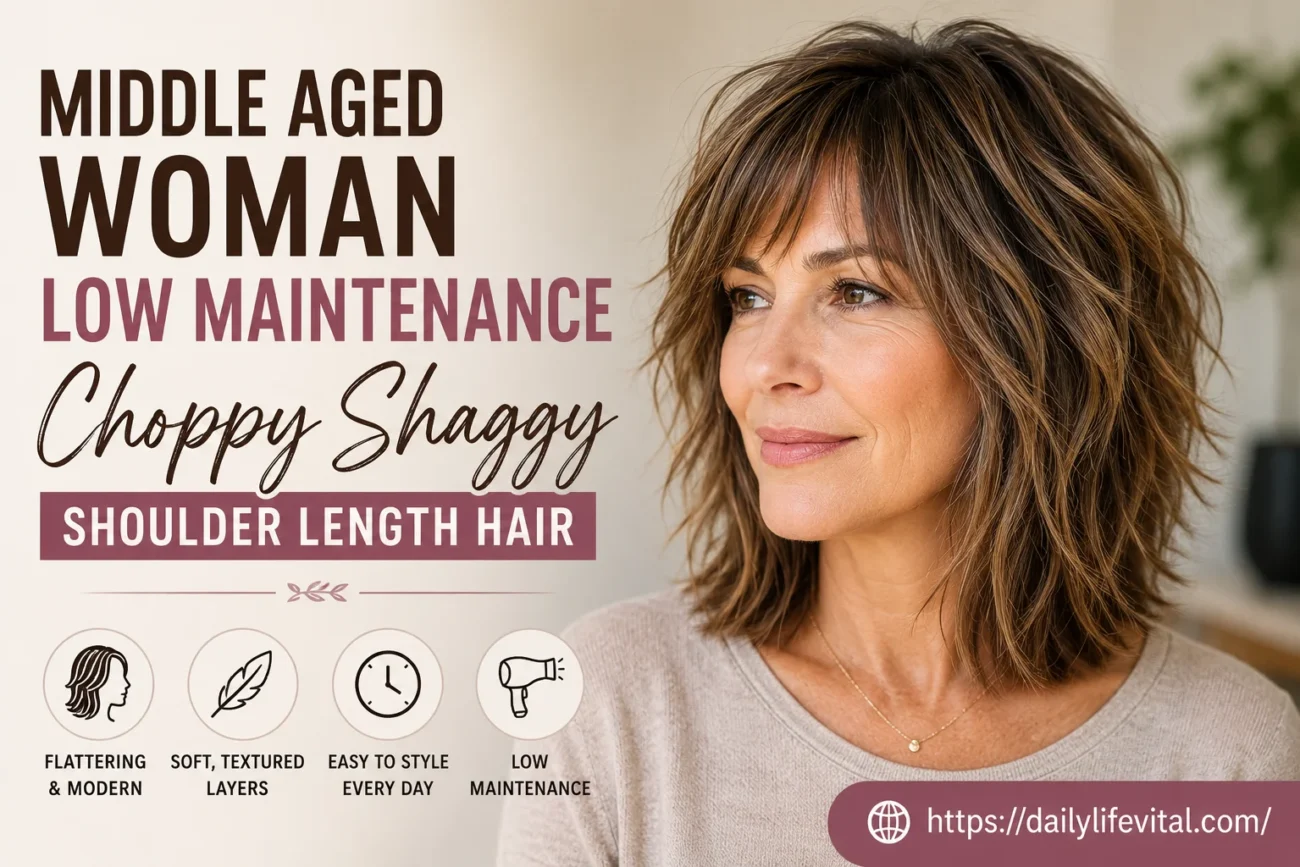
It adds volume where you’ve lost it, softens the face beautifully, works with your natural texture instead of fighting it, and genuinely requires almost no effort to look great. Here is everything you need to know about the choppy shaggy shoulder length cut.
There is one haircut that stylists keep recommending for women in their 40s and 50s above almost everything else — and it is not a pixie, not a blunt bob, and not a long straight cut that weighs down thinning hair. It is the choppy shaggy shoulder length. And there is a very good reason it keeps coming up.
Hair changes as we age. It thins. It loses the spring and elasticity it had at 25. Natural texture shifts — sometimes wavier, sometimes drier, often both. A haircut that worked beautifully in your 30s can start looking flat, heavy, or shapeless a decade later. The choppy shaggy shoulder length cut was practically designed to solve these exact problems.
It is having a major moment in 2026. Celebrity hairstylists and editorial style directors are calling it one of the year’s defining cuts — not because it is trendy, but because it is genuinely brilliant. Feathered, face-framing, textured, and endlessly wearable whether your hair is straight, wavy, fine, or thick. And the best part? Once it is cut right, the daily effort is almost nothing.
What Exactly Is the Choppy Shaggy Shoulder Length Cut?
The shag haircut has roots in the 1970s — think Stevie Nicks and Jane Fonda — but what stylists are creating in 2026 is a thoroughly modern interpretation. It keeps the spirit of the original (textured, layered, lived-in) while removing the excessive bulk and high-maintenance styling that made older versions demanding.
At shoulder length specifically, it hits a sweet spot. Long enough to feel feminine and versatile, short enough to air-dry quickly, grow out gracefully, and require almost no daily heat styling to look intentional.
The Defining Features of This Cut
- Choppy, textured layers throughout the length — not blunt, not perfectly smooth, but deliberately uneven in a way that creates movement and volume
- Face-framing pieces that soften the jaw, cheekbones, and forehead — the most important feature for flattering mature faces
- Shorter layers at the crown that create lift at the roots, which is exactly where fine or thinning hair needs it most
- Wispy, feathered ends rather than heavy blunt tips — this is what makes it look effortless rather than unkempt
- An optional fringe — curtain bangs, wispy bangs, or no bangs at all, depending on your face shape and maintenance appetite
- Length that grazes the shoulder — anywhere from collarbone to just below the shoulder is the ideal range
Style director Neale Rodger of STIL salon describes the 2026 version perfectly: “Think soft, feathered layers that build volume and create easy movement. It’s the kind of cut that still looks intentional even as it grows out.” The key shift from older interpretations is softer lines, more face-framing, and an emphasis on working with natural texture rather than against it.
Why This Cut Works So Well for Middle Aged Women
This is not a style choice born from trend-chasing. There are specific, practical reasons why hairstylists — from neighbourhood salons to editorial teams — keep landing on this cut for women in their 40s and 50s.
It Solves the Volume Problem Directly
Fine and thinning hair is one of the most common hair concerns women encounter after 40. Hormonal shifts, particularly around perimenopause, accelerate hair thinning — and a heavy, single-length cut makes this dramatically more visible. Choppy layers remove weight from the length while the shorter crown layers create lift right at the roots. The result is hair that looks measurably thicker and fuller, without a single product.
It Frames and Softens the Face
As we age, faces change — not worse, just differently. Jawlines soften, volume shifts in the cheeks, features become more angular or less defined. The face-framing layers of a choppy shag address these changes with remarkable elegance. Long pieces at the front soften the jaw. Layers around the cheekbones add the visual softness that used to come naturally. The overall effect is both younger-looking and more refined.
It Works With Natural Texture, Not Against It
Most women over 40 notice their hair becoming wavier, frizzier, or simply more unpredictable. A blunt cut amplifies these texture quirks — the unevenness becomes visible and deliberate-looking. Choppy layers absorb natural texture and make it look intentional. Wavy or slightly frizzy hair looks like artful beach waves. Straight hair looks sleek and textured. Both look effortless. This is the cut’s greatest gift to the low-maintenance woman.
It Grows Out Gracefully
Few things are more frustrating than a high-maintenance cut that looks great for two weeks and messy for the following six. The choppy shag grows out softly and intentionally. Because the layers are built to have movement and imperfection, the style continues to look good even as it gets longer between trims.
Where 2025 embraced the illusion of effortlessness through styled texture, 2026 prioritises hair health, longevity, and realistic upkeep. Trends are increasingly centred on maintaining the integrity of the hair, reducing manipulation, heat, and tension, while intentionally embracing natural texture.
Lindsay Worthen, veteran cosmetologist and campus director, Ogle School — Women.com, May 2026
Which Face Shapes It Flatters Most
The shoulder-length choppy shag is unusually versatile — it flatters almost every face shape, though the exact styling details shift depending on your features. Here is how to tailor it to you.
| Face Shape | Why It Works | What to Ask For |
|---|---|---|
| Oval | The most versatile face shape — almost any variation works beautifully | Any layer placement, any bang style; ask for what you love most |
| Round | Choppy layers elongate and add angles; side-swept or curtain bangs open the face | Layers starting at or below the chin, side-swept fringe, avoid blunt straight-across bangs |
| Square / Strong Jaw | Face-framing wispy layers soften the jaw line beautifully | Longer face-framing pieces, soft feathered ends, curtain bangs to draw eye upward |
| Long / Oblong | Shoulder length adds width; curtain bangs shorten the appearance of the face | Full curtain bangs, layers that begin at the cheekbones, avoid too much length |
| Heart | Length at the shoulder adds weight to balance a narrower chin | Side parts, wispy bangs, layers that add fullness at the jaw level |
| Diamond | Face-framing layers widen the forehead and soften the jaw simultaneously | Side-swept bangs, layers starting at the temples, avoid too much volume at the cheekbones |
For most middle-aged women regardless of face shape, layers that begin around the cheekbone or just below tend to be the most flattering placement. They frame without overwhelming, add softness without thinning, and create the face-lengthening effect that tends to be universally rejuvenating.
How It Works for Different Hair Types
One of the strongest arguments for this cut is how well it adapts to different hair textures — including the changes in texture that many women experience in their 40s and 50s.
Best Candidates
- Fine / thin hair — choppy layers create the illusion of thickness and volume where blunt cuts highlight sparseness
- Wavy hair — the cut’s best friend; natural waves become the style with zero effort required
- Straight hair — layers add movement and prevent the flat, heavy look that straight hair can develop at this length
- Transitioning / grey hair — texture and movement disguise regrowth lines beautifully; grey tones look stunning in choppy layers
Special Considerations
- Very thick hair — a shag is excellent but needs careful thinning to avoid a poofy, triangular shape; ask for internal layers
- Curly hair — possible and gorgeous, but the stylist must cut dry and account for shrinkage; avoid over-thinning
- Very fine and sparse — avoid too many layers that thin the ends further; ask for strategic layering focused on the crown
If you have fine or thinning hair, this cut is arguably the single best option available at this length. Choppy layers remove weight from the mid-lengths and ends — which is where fine hair hangs heaviest — while short crown layers push volume upward toward the roots. The result is hair that genuinely looks thicker, not just styled to appear so.
6 Gorgeous Variations to Consider
The choppy shaggy shoulder length is not one look — it is a category. Here are six of the most flattering and popular variations, all of them genuinely low maintenance.
1. The Classic Shoulder Shag with Curtain Bangs
The most popular variation and for good reason. Curtain bangs — the soft, centre-parted fringe that falls to each side — pair with choppy shoulder layers to create the most face-flattering combination in modern haircutting. The bangs frame the eyes and forehead while the layers soften the jaw. If you are only going to try one version, this is the one. Works on almost every face shape. Grows out softly. Requires minimal styling.
2. The Breezy Textured Lob Shag (No Bangs)
Not a fan of fringe? No problem. A choppy shaggy lob — the long bob — without any bangs is equally wearable and even lower maintenance. Face-framing layers that start below the cheekbone give the softening effect of bangs without requiring any forehead upkeep. This version is particularly popular for busy women who want a wash-and-go option.
3. The Wispy Fringe Shag
Lighter than a full fringe but more structured than curtain bangs, wispy bangs are the ideal middle ground for women who want some forehead coverage without commitment. They are especially flattering for fine hair — the wispy, barely-there texture adds delicacy without weight, and they blend beautifully into the face-framing layers.
4. The Modern Wolf-Shag Hybrid
The wolf cut — with its longer back layers and shorter crown — blends beautifully with shag-style choppy ends to create a more dramatic version of the classic. It has more shape and structure than a pure shag, making it feel slightly more polished for work settings. The extra crown volume is particularly good for women whose hair has thinned most at the top.
5. The Silver & Grey Textured Shag
If you are embracing your natural grey or silver — and increasingly, women in their 40s and 50s are making this choice with pride — a choppy shag is perhaps the single best cut to show it off. The layers add dimension and movement to grey tones that can otherwise look flat or wiry in a single-length style. The texture creates depth that makes silver look luminous rather than dull.
6. The Razor-Cut Shaggy Bob
The shortest variation on this list — ending at or just below the jaw rather than the shoulder — for women who want all the benefits of the shag in a more compact format. Razor-cut ends create a softer, more diffused edge than scissors alone, making this the most lived-in and effortless-looking option. It is particularly effective for very fine hair, where fewer inches of length means less weight pulling volume down.
Exactly What to Tell Your Stylist
Walking into a salon and saying “I want a shaggy cut” will get you wildly different results depending on the stylist’s interpretation. Being specific gets you what you actually want. Here is a script you can read from, adapt, or simply show your stylist directly.
“I’d like a shoulder-length shag with choppy layers throughout. I want face-framing pieces that start around my cheekbones and frame the jaw softly. Please keep shorter layers at the crown for lift and volume at the roots, and use a razor or point-cutting technique on the ends so they look wispy and feathered rather than blunt. I want this to be as low maintenance as possible — it needs to air-dry well and look good with minimal styling.”
Additional Details to Mention
Mention your hair texture honestly
Tell your stylist whether your hair is fine, thick, straight, wavy, or somewhere in between. For fine hair, ask them to focus layers on the crown and keep the ends from being over-thinned. For thick hair, ask for internal layers to remove bulk without creating a triangular shape.
Specify your bang preference clearly
Say whether you want curtain bangs, wispy bangs, no bangs at all, or face-framing layers as a bang alternative. If you are unsure, ask your stylist which option they recommend for your specific face shape — this is a great conversation to have before any cutting begins.
Bring reference photos
Save two or three photos that show the elements you want — they do not need to be the same overall look. One can show the layer placement, another the fringe style, another the texture at the ends. Stylists work much more precisely from images than from verbal descriptions alone.
Ask them to show you how to style it
Before you leave the chair, ask your stylist to walk you through exactly how to recreate the look at home. Watch what product they use, how much, and where they apply it. This five-minute conversation will save you weeks of frustration.
Do not ask for “lots of layers” without being specific about placement — this often results in over-thinned ends that look stringy rather than textured. Avoid asking for heavy, blunt-cut bangs unless you are genuinely prepared for the upkeep. And if you have fine hair, specifically ask your stylist not to thin out the ends — keep the weight there and remove it from the mid-lengths instead.
How to Style It with Minimal Effort
This is the section you came here for. The choppy shag is low maintenance — but “low maintenance” does not mean zero maintenance. It means a very short routine that produces great results consistently. Here are three routes, from absolute minimum to slightly more polished.
The Wake-Up-and-Go Method (5 minutes)
- Wash hair, squeeze out excess water gently with a microfibre towel (never rub — rubbing creates frizz and breakage in mature hair)
- While hair is damp, scrunch a small amount of lightweight mousse or curl cream through the mid-lengths and ends
- Flip your hair forward and shake it gently at the roots with your fingertips to create volume at the crown
- Let it air-dry completely — do not touch it while drying or you will lose the texture
- Once fully dry, flip upright, tousle lightly with fingers, and go
The Diffuser Method (10 minutes)
- Apply mousse or sea salt spray to damp hair as above
- Use a diffuser attachment on your hairdryer set to medium heat and low speed
- Cup sections of hair in the diffuser bowl and hold for 20–30 seconds at a time — this sets the texture without disturbing it
- Start at the crown and work down to maximise root lift
- Finish with a light spritz of texturising spray and scrunch lightly
The Polished Day Method (15 minutes)
- Apply a heat protectant and blow-dry the roots only with a round brush for maximum volume at the crown
- Let the mid-lengths and ends air-dry or use the diffuser
- If you want a little more shape, use a 1.25-inch curling wand to add a few loose bends — but leave the last inch of each section uncurled for that undone, natural finish
- Do not brush the waves after curling — run your fingers through to separate instead
- Finish with a light-hold hairspray or texturising spray
The choppy shag looks best when it looks slightly undone. If your styling goal is perfectly smooth and controlled, this is the wrong cut. If your goal is effortlessly cool and naturally textured, this is exactly right. Embrace the lived-in look — it is the whole point, and it photographs beautifully.
The Best Products for This Cut
You do not need many products for a choppy shag to look great. You need the right ones. Here is a short, practical list by product type — with a note on what each does for mature hair specifically.
| Product Type | What It Does | Best For | Amount to Use |
|---|---|---|---|
| Lightweight mousse | Adds volume and hold without weight; defines texture as hair dries | Fine to medium hair; air-dry routine | Golf-ball size, distributed through damp mid-lengths |
| Sea salt spray | Creates instant texture and a tousled, beachy finish | All hair types; used on damp or dry hair for a quick refresh | 3–4 spritzes on mid-lengths; scrunch in |
| Curl cream / defining cream | Enhances natural wave or curl; fights frizz; adds softness | Wavy or naturally textured hair | Small amount (size of a 10p coin) scrunched through damp hair |
| Texturising spray | Adds grit and separation to dry hair; revives second-day texture | All types; essential for the “undone” shag look | 1–2 spritzes at the roots on dry hair; finger-tousle after |
| Lightweight hair oil | Smooths frizz on ends; adds shine; does not weigh down fine hair | Dry or coarse mature hair; use on dry ends only | 2–3 drops warmed between palms, applied to ends only |
| Dry shampoo | Absorbs oil at roots; adds texture and volume on non-wash days | All types; extends time between washes | Spray at roots on dry hair; wait 60 seconds, then massage in |
Heavy serums, thick creams, and silicone-based smoothers will weigh down choppy layers and kill the texture that makes this cut work. The same applies to heavy-hold hairsprays — they make the hair stiff and visible rather than touchably textured. For mature hair especially, lighter is almost always better.
Maintenance: How Often and How Easy
One of the most appealing things about the choppy shaggy shoulder length cut is that it does not demand constant salon visits to look good. But “low maintenance” has a specific meaning here — it does not mean never.
Trim Schedule
For a shoulder-length shag, most stylists recommend a trim every 6 to 8 weeks. This is longer than some shorter cuts require, and shorter than you might need for a very long style. The key is keeping the layers fresh — when they grow out too much, the defining volume and texture of the cut begins to flatten. A good trim every six to eight weeks is all that is needed to keep it looking intentional.
Between salon visits, the cut genuinely requires almost nothing. Dry shampoo at the roots on non-wash days, a finger-tousle, and a spritz of texturising spray is a full “styling routine” for this cut on most days. The choppy, layered structure is forgiving by design — imperfection is part of the look.
The Wash Frequency Question
You do not need to wash this cut every day — in fact, second-day hair often looks better than freshly washed hair in a shag. The natural oils that build up slightly at the roots add weight exactly where weight is helpful (the crown), while the ends remain light and airy. Wash 2–3 times a week at most. On non-wash days, dry shampoo at the roots is your best friend.
- Trim every 6–8 weeks to keep layers fresh and the shape defined
- Wash 2–3 times per week maximum — over-washing strips moisture from mature hair
- Use a microfibre towel or old cotton t-shirt to blot-dry, never rub
- Avoid heat tools on non-styling days — the cut looks good air-dried
- Sleep on a silk or satin pillowcase to reduce frizz and breakage overnight
- Apply a weekly deep conditioning mask to keep mature hair hydrated and strong
Color Ideas That Elevate the Choppy Shag
The choppy shag is a colour-friendly cut — the layers and texture create natural dimension that makes colour look more vivid and multi-dimensional than it would on a single-length style. Here are the colour approaches that work particularly well.
Balayage and Soft Highlights
Balayage — the hand-painted highlighting technique — is an almost perfect pairing with the choppy shag. The irregular placement of lighter tones mirrors the irregular placement of the layers, creating a look that is cohesive, natural, and genuinely low-maintenance from a colour perspective. Roots growing out look intentional rather than neglected.
Face-Framing Highlights
If you want colour but are not ready for all-over highlights, face-framing pieces alone — a few lighter strips around the hairline and front sections — work beautifully with the shag’s structure. They draw the eye to the face-framing layers and brighten the complexion. This is also the lowest-maintenance colour option, as touch-ups are infrequent and grow out naturally.
Embracing Grey and Silver
The choppy shag is arguably the most flattering cut for women transitioning to natural grey or silver hair. The texture and movement of the layers give grey tones dimension and luminosity that they struggle to achieve in blunt or uniform cuts. If you are considering going grey, this is the cut to do it in.
Warm Brunette and Copper Tones
For women who colour, warm tones — copper, auburn, chestnut, honey blonde — interact beautifully with the choppy layers by catching light differently across each section. These tones also tend to be more flattering against mature skin tones than cooler shades, adding warmth to the complexion rather than competing with it.
🌿 The Bottom Line
The choppy shaggy shoulder length cut is the most practical, flattering, and genuinely low-maintenance haircut for women in their 40s and 50s. It solves the volume problem, softens and frames the face, works with natural texture instead of fighting it, and looks intentional even on your worst hair days. Get it cut right once, follow a minimal routine, and it will be the best hair decision you have made in years.
Frequently Asked Questions
Is the choppy shag suitable for very fine hair?
Yes — in fact, it is one of the best cuts for fine hair. Choppy layers create the illusion of thickness and remove weight from the lengths that would otherwise pull fine hair flat. Ask your stylist to focus layers at the crown and keep the ends from being over-thinned. The result is hair that looks noticeably fuller without any product trickery.
Can I do this cut if I have straight hair?
Absolutely. Straight hair works beautifully in a choppy shag — the layers add movement and prevent the flat, heavy silhouette that straight hair develops at shoulder length without layering. The shag works best on hair with some wave or natural texture, but with the right cutting technique (point cutting, razor cutting at the ends), it looks equally great on straight hair.
How often do I really need to trim a shoulder length shag?
Every 6 to 8 weeks is the standard recommendation. The good news is that this cut grows out more gracefully than most — the layers still look intentional even as they lengthen. You will know it needs a trim when the crown layers lose their lift and the overall shape starts to feel heavy or undefined.
Do I need curtain bangs with a shaggy shoulder length cut?
No. Curtain bangs are popular and flattering, but they are entirely optional. A choppy shag without any fringe — with face-framing layers starting below the cheekbone instead — is equally beautiful and considerably lower maintenance. If you have never had bangs and are not sure you want them, start without and see how you feel.
Will this cut work if I am transitioning to grey hair?
It is one of the best cuts for grey transitions. The choppy texture and layers give grey tones dimension, movement, and luminosity. They also help disguise the regrowth line during transition more effectively than blunt or single-length cuts. Many stylists specifically recommend this length and cut for clients going grey.
What is the difference between a shag and a wolf cut?
The wolf cut is a hybrid between the shag and the mullet — it has slightly more dramatic layers at the crown and a more defined shape at the back. The shag is softer, more feathered, and more uniformly layered throughout. Both are excellent choices. The wolf cut tends to feel slightly more structured; the shag feels more effortlessly undone. At shoulder length, the difference between them is quite subtle, and many modern cuts blend elements of both.
Can I style a choppy shag without heat tools?
Yes — this is one of its defining advantages. A choppy shag air-dries beautifully. Apply a lightweight mousse or sea salt spray to damp hair, scrunch, and let it dry naturally. The result looks like effortless beach texture. If your hair is straight and you want more texture, a texturising spray on dry hair and a quick finger-tousle is the entire routine.