
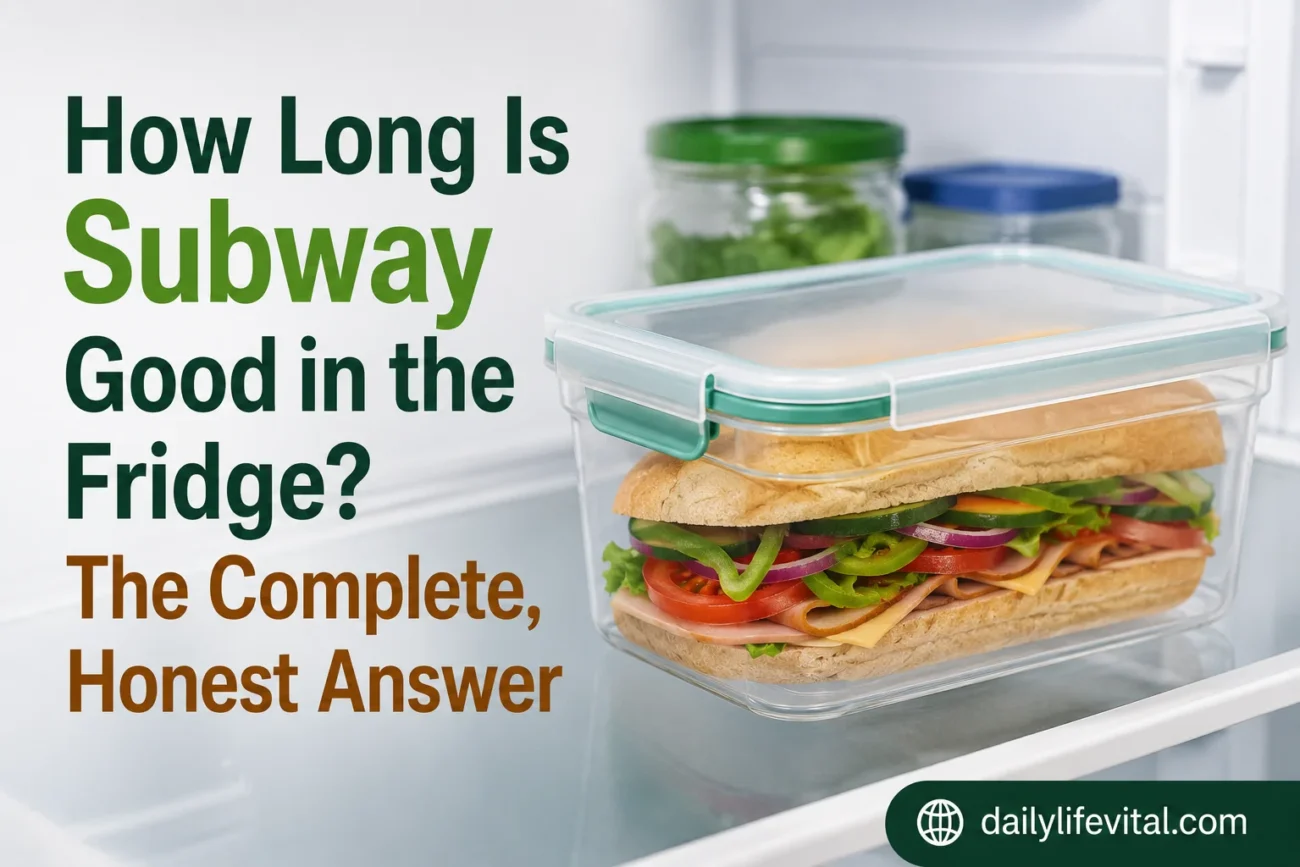
You saved half a footlong for later. Now you’re staring at it the next morning wondering if it’s still safe. Here’s exactly what the science and official food safety guidelines say — broken down by ingredient, storage method, and warning signs.
Most Subway sandwiches stay safe in the refrigerator for 3 to 4 days when stored properly — but that headline number hides a lot of important nuance. A tuna sub has a completely different timeline than a veggie sub. A sandwich wrapped tightly in an airtight container lasts meaningfully longer than one stuffed back into the paper bag. And anything left out for more than two hours before refrigerating? The clock started the moment it left the counter.
This guide covers everything: the official USDA-backed timeline, how each ingredient inside a Subway sandwich ages differently, the right way to store a sub to maximise its fridge life, and every sign that tells you it has gone bad before you take a bite you might regret.
The Quick Answer
If your Subway sandwich was refrigerated within two hours of purchase, is stored tightly wrapped at or below 40°F, and does not contain tuna or seafood — it is generally safe to eat for up to 3 to 4 days. Anything beyond that, or anything left sitting out for more than two hours before refrigerating, should be discarded.
How Long Each Type of Subway Sandwich Lasts in the Fridge
Not every sub ages the same way. The protein, sauces, and moisture level inside your sandwich determine its actual safe window — sometimes dramatically.
| Subway Sub Type | Safe Fridge Life | Key Reason |
|---|---|---|
| Turkey, Ham, Roast Beef, Chicken | 3–4 days | Standard deli meat — aligns exactly with USDA guidelines for refrigerated deli products |
| Meatball Marinara | 3–4 days | Cooked meat in sauce; high moisture but well within USDA cooked meat fridge guidelines |
| Steak & Cheese / Chicken Teriyaki | 3–4 days | Cooked proteins hold well; sauces may affect bread texture sooner than safety |
| Veggie Delite / Plant-Based | 2–3 days | No meat means lower bacterial risk, but high-moisture vegetables degrade texture quickly |
| Tuna Sub | 1–2 days maximum | Tuna salad is highly perishable — mayo-based filling with high moisture is a fast-spoiling combination |
| Egg & Cheese / Breakfast Subs | 1–2 days maximum | Eggs are among the most perishable proteins; do not push this past two days |
| BMT / Italian with lots of sauce | 3 days | Multiple processed meats hold well but heavy sauces accelerate soggy bread and texture loss |
The Subway tuna sub deserves special mention. Tuna salad — mixed with mayonnaise and other binders — is one of the most perishable fillings in any sandwich context. The USDA explicitly flags mayonnaise-based salads as items that should not be pushed beyond 1 to 2 days in the fridge. If your tuna sub has been in there for 48 hours, eat it or discard it. There is no safe “maybe one more day” with tuna salad.
How Each Ingredient Inside a Subway Sandwich Ages
A Subway sandwich is not a single food — it is a combination of several perishable ingredients, each with its own spoilage timeline. When you store them together, the fastest-spoiling ingredient sets the limit for the whole sandwich.
The Bread
Subway bread on its own would last two or three days before going stale. But once it is assembled with fillings, it begins absorbing moisture from vegetables, sauces, and meat. That moisture absorption is what creates the soggy texture most people notice first when eating a stored sub. Soggy bread is primarily a quality issue, not a safety issue on its own — but it signals that the moisture environment inside the sandwich has been building up, which also accelerates the growth of bacteria and mould.
Deli Meats (Turkey, Ham, Chicken, Roast Beef)
Standard deli meats are preserved to last longer than raw meat, but they are still highly perishable once exposed to air, handling, and moisture from other sandwich ingredients. The USDA specifies that opened deli meats stored in a refrigerator are safe for 3 to 5 days. When assembled into a sandwich — where they are in contact with vegetables, bread moisture, and sauces — the practical safe window is 3 to 4 days.
Deli meats are a known source of Listeria monocytogenes — a bacterium that, unlike most foodborne pathogens, can grow slowly even at refrigerator temperatures. This is particularly important for pregnant women, older adults, young children, and people with weakened immune systems. The USDA advises these groups to be especially cautious with deli meat storage and to heat deli meats thoroughly before eating if there is any uncertainty about storage duration.
Lettuce and Leafy Greens
Lettuce has a different problem from meat — it does not become unsafe as quickly, but it becomes visually and texturally unpleasant very fast. After 24 hours in a sealed sandwich, lettuce begins to wilt and release water. After 48 hours, it is typically slimy and unappetising. Wilted, slimy lettuce is a reliable early warning signal that the sandwich has been sitting long enough to start deteriorating.
Tomatoes and Cucumbers
High-moisture vegetables like tomatoes and cucumbers are the fastest contributors to bread sogginess. Tomatoes in particular release significant liquid as they sit. Within 12 to 24 hours, the section of bread touching tomatoes will be noticeably soggy. Beyond two days, these vegetables often become slimy — and slimy vegetables are a clear spoilage indicator.
Pickles and Jalapeños
Pickled vegetables are an interesting exception. Pickles and jalapeños are naturally preserved in vinegar brine, so they hold up significantly better than fresh vegetables in terms of safety. However, they still release liquid into the sandwich and will accelerate bread sogginess. Their extended safety does not compensate for the other ingredients they are paired with.
Sauces and Condiments
This is where the biggest variation lies. Oil and vinegar-based sauces are relatively stable and do not accelerate spoilage significantly. Cream-based sauces — mayonnaise, ranch, chipotle mayo, Caesar — are a different matter entirely. These are the most perishable condiments in any sandwich context. Food safety experts specifically note that once cream-based dressings are exposed to air, handling, and the moisture environment of a sealed sandwich, bacterial growth accelerates. A sub drenched in chipotle mayo should be treated toward the shorter end of the storage window.
Cheese
Cheese is one of the more durable ingredients in this context. Processed cheese slices — which Subway uses most commonly — last well within a 3 to 4 day window at refrigerator temperature. Natural cheese varieties may develop an off texture or odour a day sooner. In either case, the cheese itself is rarely the first ingredient to signal a problem.
The USDA Food Safety Rules That Apply to Your Sub
Several official USDA Food Safety and Inspection Service (FSIS) guidelines apply directly to leftover Subway sandwiches. These are not suggestions — they are the standards established by food safety science.
The 2-Hour Rule
Perishable food — including takeout sandwiches — must be refrigerated within 2 hours of purchase or preparation. If the temperature is above 90°F (32°C), that window shrinks to 1 hour. This is the USDA’s official guideline for take-out foods. If your sub sat in your car, on your desk, or on a counter for longer than 2 hours before going into the fridge, discard it. Refrigerating it afterward does not make it safe.
The 40°F Fridge Temperature Rule
Your refrigerator must be set at or below 40°F (4°C) to meaningfully slow bacterial growth. The USDA identifies the range between 40°F and 140°F as the “danger zone” — the temperature window in which bacteria can double in number in as little as 20 minutes. Many home fridges run slightly warmer than their dial indicates. Use an inexpensive fridge thermometer to verify the actual temperature.
The 3–4 Day Leftover Rule
The USDA recommends using most cooked leftovers within 3 to 4 days of refrigeration. For deli sandwiches specifically, their guidance on take-out foods states that perishable leftovers should be refrigerated promptly and consumed within this window. This is the foundational guideline behind the 3–4 day estimate for Subway sandwiches.
The Reheating Temperature Rule
If you reheat a refrigerated Subway sandwich — particularly a toasted hot sub — the USDA recommends heating it to an internal temperature of 165°F (74°C). This ensures any bacteria that developed during storage are destroyed. Note: reheating kills bacteria but does not neutralise toxins that some bacteria have already produced. This is why staying within the 3–4 day window is non-negotiable, not just a texture preference.
A common misconception is that reheating a sandwich that has been in the fridge for 5 or 6 days makes it safe again. It does not. Heating kills live bacteria, but certain bacterial toxins — particularly from Staphylococcus aureus — are heat-resistant and remain in the food even after thorough cooking. Once the 3–4 day window has passed, the sandwich should be discarded, not reheated.
How to Store a Subway Sandwich to Maximise Fridge Life
Storage method makes a real, measurable difference. A well-stored sub can last the full 3 to 4 days comfortably. A poorly stored one may be unpleasant or even unsafe after just 24 hours.
The Best Storage Method (Step by Step)
- Do not discard the Subway paper wrapping — keep it on as the first layer. It provides some initial protection and keeps the sandwich shape intact.
- Wrap tightly in plastic wrap or aluminium foil over the paper wrapper. The goal is to eliminate air contact as completely as possible. Air accelerates spoilage by drying the bread and oxidising the fillings.
- Place the wrapped sandwich in an airtight container. This double-layer approach is the most effective storage method. The container also prevents the sub from absorbing odours from other foods in the fridge.
- Store in the coldest part of the fridge — the back of the middle shelf, not the door. The door is the warmest zone in any refrigerator; it warms every time the door opens. The back of the fridge maintains the most consistent temperature.
- Label the container with the date. This removes any guessing about how long it has been in there. Write the date you refrigerated it, not the date you might eat it.
The Smart Ordering Strategy for Planned Leftovers
If you know in advance that you are saving part of a Subway sandwich for later, the best thing you can do is ask for the wet toppings on the side. Order the sub with meat and cheese only, and get the tomatoes, cucumbers, pickles, lettuce, and sauces in separate small containers or bags.
Store the bread-and-meat portion separately from the vegetables. When you are ready to eat, add the fresh toppings. This approach extends freshness by a full day or more because it eliminates the main cause of quality deterioration: moisture from vegetables soaking into the bread.
If your Subway is already assembled and you are planning to eat it tomorrow, remove the lettuce and tomato slices before refrigerating if you can do so easily without dismantling the whole sandwich. Store them in a small separate container and add them back when you eat. Your bread will be in significantly better shape the next day.
6 Signs Your Subway Sandwich Has Gone Bad
Regardless of how many days it has been in the fridge, always do a quick check before eating any stored food. Your senses are reliable early warning systems — and with deli meat sandwiches specifically, there are clear signals to look for.
Still Safe — These Are Normal
- Bread slightly firmer or drier than fresh — normal texture change from refrigeration
- Mild compression of the sandwich shape — just from being wrapped and stored
- Lettuce slightly wilted but not slimy — acceptable within the first 24 hours
- Cheese slightly firmer — cheese firms up in cold temperatures, not a safety issue
Discard Immediately — These Mean It’s Bad
- Any sour, rotten, or ammonia-like smell from the meat or overall sandwich
- Slimy texture on the meat or vegetables — a clear sign of bacterial decomposition
- Visible mould anywhere on the bread, meat, vegetables, or cheese
- Bread is thoroughly soggy and the sandwich also smells off (sogginess alone is texture, sogginess plus odour is spoilage)
- Meat has changed colour significantly — greyish or greenish tones on deli meat
- Any sour, bitter, or “wrong” taste on the first bite — stop immediately and discard
This is the USDA’s own guidance — and it is worth repeating. You cannot reliably tell whether deli meat contains dangerous levels of bacteria by smell or appearance alone. Listeria monocytogenes in particular can grow in food that looks and smells completely normal. If you are uncertain about how long a sandwich has been refrigerated, do not eat it. No sandwich is worth the risk of foodborne illness.
Can You Freeze a Subway Sandwich?
Yes — with important limitations. Freezing can extend the life of a Subway sandwich to 1 to 3 months, but the result when thawed varies widely depending on what is inside it.
| Freezes Well | Does Not Freeze Well |
|---|---|
| Plain meat and cheese subs (no sauce, no fresh veg) | Subs with lettuce, tomato, or cucumber — these become watery and slimy when thawed |
| Meatball marinara (sauce acts as a moisture barrier) | Tuna salad or egg-based subs — texture completely breaks down in freezer |
| Chicken or steak subs without cream sauces | Anything with mayonnaise or cream-based dressings — mayo separates on thawing |
| Bread itself freezes reasonably well when tightly wrapped | Pickles and vinegar-heavy additions — the brine can make bread soggy on thawing |
How to Freeze a Subway Sandwich Correctly
- Remove any fresh vegetables and sauces before freezing
- Wrap the sandwich tightly in plastic wrap, then wrap again in aluminium foil
- Place in a freezer-safe zip-lock bag and squeeze out as much air as possible
- Label with the date — safe for up to 1 to 3 months in a freezer at 0°F
- Thaw in the refrigerator for 24 hours — never thaw on the counter, where the outer layers reach danger zone temperatures while the centre is still frozen
- After thawing, add fresh vegetables and sauce and eat within 24 hours
How to Reheat a Refrigerated Subway Sandwich
If you have a toasted hot sub that you want to warm back up, there are two methods that work well — and one approach to avoid entirely.
Oven or Toaster Oven (Best for Texture)
- Preheat to 350°F (175°C)
- Remove any lettuce, tomato, or cold toppings before reheating — add them back after
- Wrap loosely in foil if you want a softer result, or leave unwrapped for a crispier bread exterior
- Heat for 8 to 10 minutes until the internal temperature reaches 165°F
- Use a food thermometer to verify — especially important for chicken or turkey subs
Microwave (Fast but Softer)
- Remove all cold toppings (lettuce, tomato, cucumber, fresh vegetables)
- Wrap in a damp paper towel to prevent the bread from drying out completely
- Microwave in 30-second bursts until heated through — typically 60 to 90 seconds total
- Check the internal temperature reaches 165°F
- Add fresh toppings after microwaving
The USDA specifically states that slow cookers and chafing dishes are not appropriate for reheating leftovers. They may keep food in the danger zone (40–140°F) for too long before reaching a safe temperature, which can allow bacterial growth rather than eliminating it.
What Happens If You Eat a Bad Subway Sandwich
Understanding the consequences of eating a spoiled deli sandwich is part of understanding why the storage guidelines matter — especially for certain groups.
Typical Food Poisoning Symptoms
Symptoms of foodborne illness from a spoiled sandwich typically appear anywhere from 30 minutes to 48 hours after eating contaminated food, depending on the type of bacteria involved. Common symptoms include:
- Nausea and vomiting
- Stomach cramps and abdominal pain
- Diarrhoea — sometimes severe
- Fever and chills
- Headache and general weakness
Most healthy adults recover from typical deli meat food poisoning within 24 to 48 hours with rest and fluids. However, the consequences are considerably more serious for vulnerable groups.
Higher-Risk Groups Who Should Be Extra Cautious
- Pregnant women — Listeria from deli meat can cause miscarriage, premature birth, or serious illness in newborns. The CDC recommends that pregnant women heat deli meats to steaming before eating, even when fresh.
- Older adults (65+) — immune systems become less effective with age, making recovery from foodborne illness slower and more complicated
- Young children — smaller body weight means a lower bacterial dose threshold for serious illness
- People with weakened immune systems — including those on immunosuppressant medications, chemotherapy patients, and people with HIV/AIDS
Most food poisoning resolves on its own. Seek medical attention if symptoms include a high fever (above 103°F / 39.4°C), blood in stool or vomit, signs of dehydration (extreme thirst, no urination, dizziness), or if symptoms persist beyond 48 to 72 hours without improving. This is especially important for pregnant women, the elderly, young children, and immunocompromised individuals.
🌿 The Complete Summary
A properly stored Subway sandwich — wrapped airtight and kept at or below 40°F — is safe to eat for 3 to 4 days for most sub types. Tuna and egg-based subs should be eaten within 1 to 2 days. Any sub left at room temperature for more than 2 hours before refrigerating should be discarded regardless of how it looks. Store it tightly, label it with the date, keep wet toppings separate when possible, and always trust your nose and eyes before taking a bite.
Frequently Asked Questions
Is a Subway sandwich still good after 4 days in the fridge?
This is the edge of the safe window according to USDA guidelines. If the sandwich was stored properly from the start — refrigerated within two hours, wrapped airtight, at or below 40°F — day four is technically still within the recommended timeframe for most sub types. However, quality will have declined significantly: the bread will be soggy, and fresh vegetables will be limp or slimy. Always check for spoilage signs before eating. If anything smells, looks, or feels off, discard it.
Can I eat Subway the next day?
Yes — a refrigerated Subway sandwich is safe to eat the following day for all standard sub types, provided it was refrigerated promptly and stored properly. Day-old subs are well within the 3 to 4 day safe window. Expect some texture changes, particularly in the bread and fresh vegetables, but there are no food safety concerns.
How long is a Subway tuna sub good in the fridge?
No more than 1 to 2 days. Tuna salad — mayonnaise-based with high moisture content — is one of the most perishable fillings in any sandwich. The USDA specifically flags mayonnaise-based salads as items that should not be stored beyond this window. If your tuna sub has been in the fridge for two days, that is the absolute limit.
Can I eat a Subway sandwich that was left out overnight?
No. A Subway sandwich left out at room temperature for more than 2 hours should be discarded, regardless of how it looks or smells. Bacteria multiply rapidly in the danger zone (40–140°F), and a sandwich left out overnight has been in that temperature range for far longer than is safe. Refrigerating it afterward does not make it safe again.
Does a Subway sandwich last longer if it’s wrapped in the original paper?
The original Subway paper wrapping provides minimal protection on its own — it is permeable to air and does not create a seal. For real fridge life, you need to wrap the sandwich in plastic wrap or foil over the paper wrapper, then place it in an airtight container. The paper is a good first layer but insufficient on its own.
What is the best way to keep a Subway sandwich fresh in the fridge?
The best approach: keep the paper wrapper, add a layer of plastic wrap over it, place in an airtight container, and store at the back of the middle shelf (the coldest, most temperature-stable spot in the fridge). For maximum freshness, store the bread-and-protein portion separately from wet toppings and sauces, and add those fresh when you eat. Label the container with the date so there is no guessing.
Can I freeze a Subway sandwich to make it last longer?
Yes, but with limitations. A plain meat-and-cheese sub without fresh vegetables or cream-based sauces can be frozen for up to 1 to 3 months when wrapped tightly. Sandwiches with lettuce, tomato, cucumber, or mayonnaise do not freeze well — the vegetables become slimy and the mayo separates on thawing, resulting in an unappetising texture. Thaw frozen subs in the refrigerator overnight, never on the counter.