
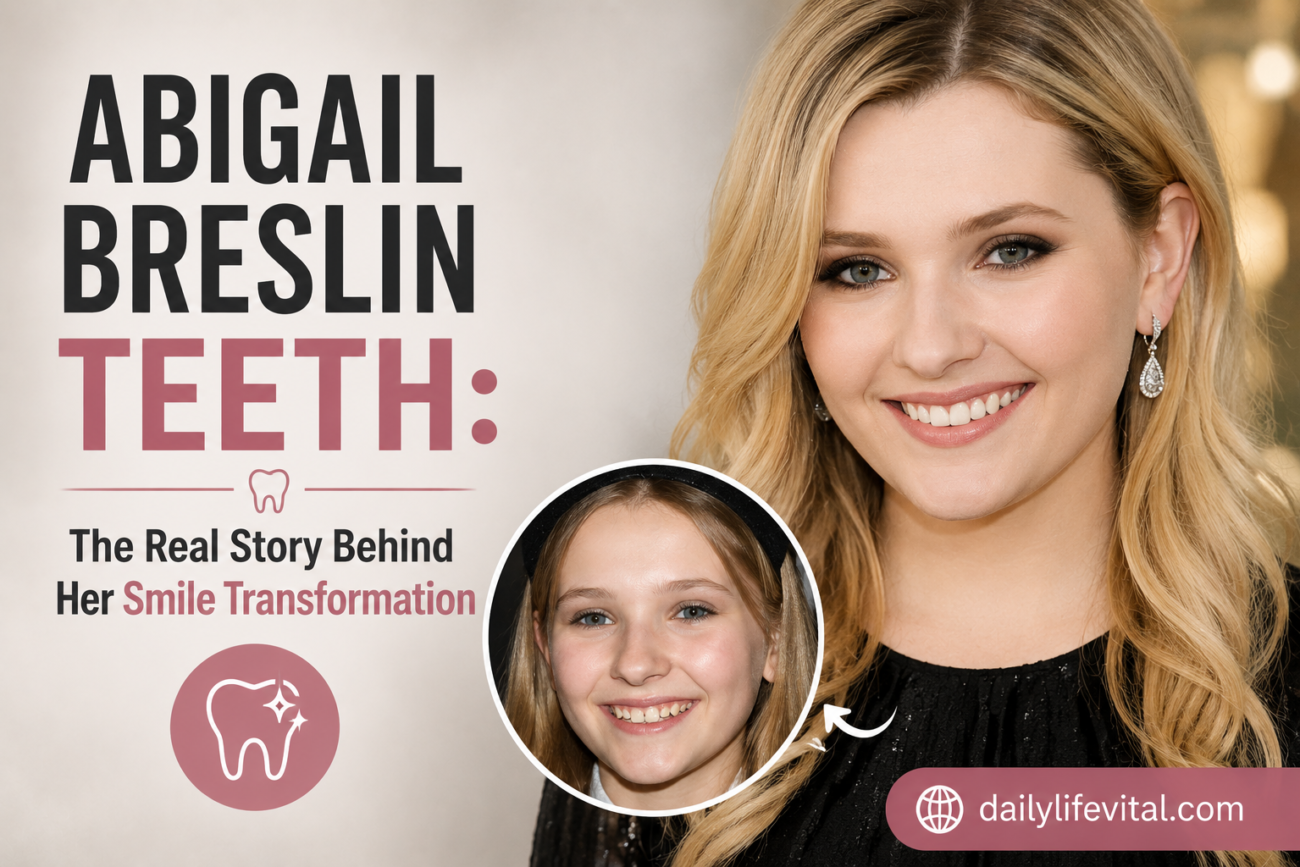
From a gap-toothed ten-year-old stealing scenes in Little Miss Sunshine to a polished thirty-year-old on the 2026 Sundance red carpet — here is an honest, science-grounded look at what actually changed, what likely caused it, and what all the viral before-and-after comparisons keep getting wrong.
Abigail Breslin’s smile is one of the most recognised in modern American cinema. That slightly gappy, completely natural grin that made Olive Hoover so endearing in 2006 is now something quite different — brighter, more aligned, more polished. And the internet has opinions about why.
Most of those opinions are wrong. Or at least, they are dramatically overstated. The reality of what happened to Abigail Breslin’s teeth sits in far more ordinary territory than the viral before-and-after posts suggest — and understanding it properly means understanding something most people never learned about how teeth actually change between childhood and adulthood.
This article covers her full dental evolution, the science behind childhood tooth development, the cosmetic procedures that are genuinely plausible, the ones that almost certainly were not involved, and why most celebrity “teeth transformation” coverage mistakes normal human biology for dramatic cosmetic surgery.
Who Is Abigail Breslin?
Abigail Kathleen Breslin was born on April 14, 1996, in New York City — which means she turned 30 in April 2026, and has now spent more than two-thirds of her life working as a professional actress. She is the daughter of Kim Walsh, a talent manager, and Michael Breslin, a telecommunications consultant, and the younger sister of actors Ryan and Spencer Breslin.
She made her first commercial appearance at age three and her film debut at five, playing Bo Hess alongside Mel Gibson in M. Night Shyamalan’s science fiction thriller Signs (2002). But the role that changed everything came four years later.
In 2006, at the age of ten, Breslin played Olive Hoover in the indie comedy-drama Little Miss Sunshine — a performance so naturalistic and emotionally precise that she became the fifth youngest actress ever nominated for the Academy Award for Best Supporting Actress. Her co-stars Greg Kinnear and Alan Arkin both publicly described being “astounded by her seriousness of purpose” on set.
Following Little Miss Sunshine, she built a genuinely varied career across genres — Zombieland (2009), My Sister’s Keeper (2009), August: Osage County (2013), the Fox horror-comedy series Scream Queens (2015–2016), Stillwater (2021) opposite Matt Damon, and most recently The Italians (2025) and the Netflix series The Night Agent (2026). She married Ira Kunyansky in January 2023.
That career arc — from gap-toothed ten-year-old to polished thirty-year-old — is precisely the timeline over which people notice and discuss her dental changes.
What People Are Noticing — and Why It Drives Searches
The searches for “Abigail Breslin teeth” are not random. When viewers compare photographs from her Little Miss Sunshine era to her recent red carpet appearances — particularly the Little Miss Sunshine 20th anniversary screening at the 2026 Sundance Film Festival — the difference is real and visible.
Early career photos show a child with a characteristically childhood smile: slightly gapped front teeth, smaller teeth not yet fully emerged, natural unevenness in alignment, and a generally unpolished appearance that reads as charming and authentic precisely because it was. More recent photographs show a woman with visibly brighter, more evenly spaced, and better aligned teeth — a smile that looks intentionally maintained rather than naturally occurring.
A smile is one of the most recognisable features of any public figure. Viewers who follow an actor’s career over two decades develop an unconscious reference point for how that person looks. When the smile shifts — even gradually, even naturally — it registers as notable. That noticing is human and accurate. The mistake is in the interpretation: assuming that visible change automatically means dramatic cosmetic intervention.
The Early Smile: 2002–2009
In her earliest film and promotional photographs — from Signs through her appearances in Raising Helen (2004) and into Little Miss Sunshine (2006) — Abigail Breslin’s teeth showed exactly what you would expect from a child between the ages of five and ten: primary teeth giving way to permanent ones, visible gaps between the front teeth, and an overall smile that was charmingly imperfect in the way that childhood teeth always are.
The gap between her two central front teeth in her Little Miss Sunshine photographs became part of the character’s identity. Olive Hoover was a child who dreamed of beauty pageants despite being, in every conventional sense, an unlikely candidate — and that natural, unpolished smile contributed directly to how audiences connected with the character. Casting director Kim Davis had searched extensively before finding Breslin. That authentic, unstyled quality was not incidental; it was the point.
If Olive had been played by any other little girl, she would not have affected us as mightily as she did.
Claudia Puig, USA Today — reviewing Abigail Breslin’s performance in Little Miss Sunshine
Through Zombieland (2009) — where she played Little Rock at age thirteen — her teeth were visibly transitioning. The gap had reduced, the teeth were larger and more established, and the overall smile was beginning to look more adolescent than childlike. This is exactly the developmental pattern that paediatric dentists describe as typical for children between ages ten and fourteen.
The Science Behind Childhood Dental Development
This section is the most important one — and the one most celebrity dental articles skip entirely. Understanding it makes everything else fall into place.
Children have twenty primary (baby) teeth. These begin erupting around six months of age and are usually fully present by age three. From approximately age six through to age twelve or thirteen, those primary teeth are progressively replaced by thirty-two permanent adult teeth — a process called mixed dentition. During this transition, children’s smiles go through a period of natural gaps, asymmetry, and unevenness that has nothing to do with dental health problems.
The two central front teeth that most people photograph and remember are among the earliest permanent teeth to emerge — typically between ages six and eight. When they first come in, they are often proportionally large for the child’s face and may appear gapped or slightly splayed. This gap — called a diastema — is extremely common in early childhood and frequently closes naturally as the lateral incisors emerge on either side, exerting gentle pressure inward.
Most of the change people observe when comparing Abigail Breslin’s childhood smile to her adult smile is simply human biology doing exactly what it is supposed to do. The gap closed. The teeth proportioned out relative to a maturing face. The jaw grew. The cheekbones developed. All of this changes how teeth look even if the teeth themselves have not changed at all.
How Jaw Growth Changes a Smile Without Touching the Teeth
Beyond tooth development, facial bone growth in adolescence dramatically changes how a smile appears on camera. As the jaw, cheekbones, and surrounding soft tissue mature — typically through the mid-to-late teens — the frame around the teeth shifts. Slightly different lip positions, a changed bite relationship between upper and lower jaws, and fuller or differently shaped cheeks all alter how much of the teeth is visible, how the teeth appear to line up, and how the overall smile reads in a photograph. A smile that looked wide and gappy in a narrower childhood face may look perfectly proportioned in a fully developed adult face — without a single procedure having occurred.
The Adult Smile: 2013 to Present
By the time Breslin appeared in August: Osage County and The Call in 2013 — at age seventeen — her smile had undergone most of its natural developmental transformation. The gap was largely closed. The teeth were adult-sized and better proportioned to a maturing face. The alignment was noticeably improved relative to the childhood photographs.
In photographs from her Scream Queens era (2015–2016) and beyond, the difference is primarily one of brightness and polish rather than structural change. Her teeth appear whiter, more consistently toned, and her overall smile looks groomed in a way that childhood photographs did not — which aligns with both professional whitening treatments and general improvements in grooming standards that accompany adult careers in entertainment.
At the Little Miss Sunshine 20th anniversary screening at the 2026 Sundance Film Festival, photographs of Breslin alongside co-stars Paul Dano, Toni Collette, and Greg Kinnear provided the most striking recent before-and-after comparison for observers. Standing on the same red carpet as a documentary record of where she began, the evolution was visible — and entirely consistent with a person who spent twenty years maturing naturally while also receiving professional dental maintenance.
The Stillwater Teeth — A Special Case Worth Understanding
Stillwater (2021), directed by Tom McCarthy and co-starring Matt Damon, generated a specific round of interest in Breslin’s teeth that deserves its own explanation — because it created confusion that is still circulating online.
In the film, Breslin plays Allison, an American woman imprisoned in France who maintains her innocence against a serious crime. The character’s circumstances required an authentic, unglamorous appearance — including deliberately aged and neglected-looking teeth. This was achieved through character makeup applied by the film’s makeup department using safe, temporary dental cosmetics.
Multiple online articles and forum threads treat Abigail Breslin’s appearance in Stillwater as evidence of real dental problems or a “deteriorated” smile. This is incorrect. The darkened and imperfect teeth visible in certain Stillwater promotional images and screenshots were intentional character makeup — applied for the role and washed off after filming. They reflect nothing about Breslin’s actual dental health.
Breslin herself described her preparation for the role as deeply immersive — she researched real-life cases of wrongful imprisonment to understand Allison’s psychology. The physical transformation, including the dental makeup, was part of that commitment to the role. Treating film makeup as evidence of real dental changes is one of the more common errors in celebrity dental coverage.
What Dental Procedures Most Likely Happened
Once natural development is accounted for, what remains? There are several common, minimally invasive dental treatments that align with the brightness and finish of Breslin’s adult smile — and they are overwhelmingly the most probable explanations.
Professional Teeth Whitening
This is the most likely and most common intervention among public figures in entertainment, and it creates the most visible single change that observers notice between early and recent photographs. Professional whitening — either in-office treatments or custom take-home trays with professional-grade peroxide gels — can lift enamel tone by several shades and create the bright, even colour that reads as “Hollywood teeth” on camera. Unlike structural changes, whitening leaves no permanent alteration to the tooth itself and can be maintained with periodic top-up treatments. The shift from her natural, slightly off-white childhood tooth colour to the brighter adult tone is highly consistent with professional whitening begun at some point in her mid-teens.
Orthodontic Alignment
There is no confirmed record of Breslin wearing traditional braces. However, the progressive improvement in tooth alignment visible across her late-teen photographs — beyond what natural development alone explains — is consistent with subtle orthodontic intervention. Clear aligner therapy, which uses a series of nearly invisible removable trays to gradually shift teeth, is now the most popular choice for adult and adolescent patients in high-visibility environments precisely because it leaves no visible hardware. Many child actors and public figures undergo clear aligner treatment during school years without any public mention of it.
Dental Bonding or Contouring
Dental bonding involves applying a tooth-coloured composite resin to smooth rough edges, fill small gaps, or correct minor chips. Contouring involves gentle reshaping of enamel to improve symmetry. Both are conservative, reversible procedures that leave the natural tooth structure largely intact. The improvements in Breslin’s adult smile — which appear enhanced rather than replaced — are more consistent with bonding and contouring than with more aggressive interventions.
The most credible explanation for Abigail Breslin’s dental evolution is a combination of natural childhood-to-adult development (which accounts for the majority of the change), professional whitening (which accounts for the brightness difference), and possibly minor orthodontic alignment or bonding (which accounts for any remaining refinement). This is the dental history of a large proportion of public figures who grew up on screen. It is not dramatic. It is not scandalous. It is careful, incremental maintenance.
What Almost Certainly Did Not Happen
The internet’s preferred explanation for any celebrity with noticeably attractive teeth is veneers. This deserves a direct rebuttal.
Signs of Veneer Treatment
- Unusually uniform tooth shape — all teeth precisely the same width and length
- An opacity or flatness to the tooth surface that differs from natural enamel
- An abrupt transition between early and late career photos — dramatic overnight change
- Teeth appearing “too perfect” with a plastic, porcelain-like quality in photographs
- A noticeably wider or more rectangular smile shape than was present earlier
What Breslin’s Smile Actually Shows
- Natural tooth shape retained — no uniform artificial width or length visible
- Gradual improvement across years, not an abrupt single transformation
- Smile retains individual character — not the perfect symmetry of full veneers
- Changes consistent with growth, whitening, and conservative refinements
- No credible reports or dental professional assessments confirming veneers
Porcelain veneers involve removing a thin layer of enamel from the front surface of each tooth — an irreversible process. The result is typically a highly uniform, artificially symmetrical smile that looks noticeably different from natural teeth in person and on camera. Breslin’s smile does not exhibit these characteristics. The changes visible across her career look like the result of enhancement rather than replacement — which is the hallmark of conservative dentistry, not veneers.
How Camera Angles, Lighting, and Lenses Mislead Everyone
Before drawing any conclusion from a celebrity teeth comparison, it is worth understanding how profoundly photographs can misrepresent dental reality.
| Photography Factor | How It Distorts Perceived Tooth Appearance |
|---|---|
| Lens focal length | Wide-angle lenses used in red carpet photography can broaden the centre of the face, making front teeth appear larger or more prominent than they are in person |
| Lighting temperature | Warm lighting makes teeth appear yellower; cool or blue-tinted lighting makes them appear whiter and brighter — even with no change in the actual enamel tone |
| Flash intensity | High-powered camera flash bleaches tooth colour in photographs, creating a “brilliant white” appearance that does not reflect the actual shade in normal light |
| Lip position | How far the lips part and how high the upper lip rises during a smile varies from photo to photo and changes how much of each tooth — and which teeth — are visible |
| Motion blur and angle | A tooth that appears “missing” in one photograph is almost always shadow, motion blur, or the lip covering part of the tooth — not an actual gap or absent tooth |
| Photo retouching | Most professionally distributed celebrity photographs undergo at least basic retouching; teeth are commonly brightened and smoothed as a standard editorial step |
Before concluding that a celebrity has had dental work based on a photo comparison, check whether the same difference appears consistently across multiple photographs from different events, angles, and photographers. A single dramatic-looking screenshot almost never constitutes reliable evidence of anything. Look for a pattern across many images before drawing any conclusion.
What Abigail Breslin’s Smile Story Actually Teaches Us
Beyond the question of what specifically happened to one actress’s teeth, Breslin’s dental evolution offers a useful lens through which to understand celebrity smile coverage more broadly — and our own relationship with dental aesthetics.
Most “Transformations” Are Accumulations
Nobody wakes up with a dramatically different smile overnight. The changes that attract the most attention — and generate the most viral comparison posts — are almost always the accumulated result of years of small, incremental steps: natural development, annual whitening, possibly a round of clear aligners, regular cleaning and polishing, and improvements in professional makeup and photography. Each individual step is invisible. The sum of twenty years of them is what people zoom in on.
Child Stars Face an Unfair Benchmark
Abigail Breslin became famous at an age when human teeth are by definition impermanent and transitional. Every child between ages six and fourteen has teeth that are changing, gapping, and replacing. Photographing that process and then comparing it to the adult result as evidence of “dental work” is a misunderstanding of basic biology. The bar for what counts as “transformation” is set impossibly low when the baseline photograph was taken during childhood dentition.
Conservative Dentistry Is Not “Fake” Dentistry
Professional whitening, clear aligners, and dental bonding are maintenance-level interventions — comparable in their scale of impact to a professional haircut or skincare routine. They improve upon what is already there rather than replacing it. Treating them as equivalent to veneers or full cosmetic rebuilding is a misreading of what actually distinguishes maintained natural teeth from prosthetic ones.
Confidence Changes How a Smile Reads
Breslin has spoken publicly about navigating body image pressures as a child actor, including experiences with disordered eating during her teens. The confidence and ease visible in her current public appearances — including how she smiles — reflects a woman who has done meaningful personal work alongside her professional development. A genuine, comfortable smile photographs differently from a guarded or self-conscious one. Some of what observers interpret as dental change is simply a person smiling differently because they feel differently.
🌿 The Bottom Line
Abigail Breslin’s teeth look different in 2026 than they did in 2006 for reasons that are almost entirely mundane: natural childhood-to-adult dental development accounts for the structural changes, professional whitening accounts for the brightness difference, and minor cosmetic refinements likely account for whatever remains. The Stillwater teeth were character makeup. The veneers theory is not supported by the visual evidence. What Breslin actually has is the smile of someone who grew up carefully and maintained it professionally — which is, ultimately, the story of most people in Hollywood who look after their dental health without doing anything dramatic.
Frequently Asked Questions
What happened to Abigail Breslin’s teeth?
The most accurate answer: mostly natural development. The visible changes between her childhood photographs and current appearances are largely the result of normal dental maturation — gaps closing as permanent teeth and surrounding jaw structure developed fully — combined with professional whitening and likely minor cosmetic refinements such as bonding or clear aligner alignment. No dramatic cosmetic overhaul is supported by the visual evidence.
Did Abigail Breslin get veneers?
There is no confirmed report of veneers, and the visual characteristics of her smile do not strongly suggest them. Veneers typically create a highly uniform, artificially symmetrical appearance with a particular surface quality that is distinguishable from natural enamel. Breslin’s smile retains individual character and has changed gradually rather than abruptly — both of which argue against full veneer treatment.
Why did Abigail Breslin have different teeth in Stillwater?
The darkened, aged-looking teeth visible in some Stillwater (2021) images were character makeup applied by the film’s makeup department to suit her role as an imprisoned woman living in difficult circumstances. This is a standard technique in film production and has no bearing on Breslin’s actual dental health or appearance. The effect was temporary and completely reversed after filming.
Did Abigail Breslin wear braces?
There are no confirmed public reports of Breslin wearing traditional braces. However, the gradual alignment improvement visible in photographs from her mid-to-late teens is consistent with clear aligner therapy, which is virtually invisible and commonly used by young people in public-facing careers. Whether she used clear aligners has never been publicly confirmed.
Why do Abigail Breslin’s teeth look so different from Little Miss Sunshine?
Because she was ten years old in Little Miss Sunshine and is thirty now. The primary reason for the difference is twenty years of natural facial and dental development. Children between ages six and fourteen have teeth in a state of active transition — gaps, asymmetry, and unevenness are biologically normal at those ages. The adult smile that replaced those childhood teeth through natural development is the largest single contributor to the difference people observe.
Has Abigail Breslin ever talked about her teeth publicly?
She has not made her dental care a subject of public discussion. Unlike some public figures who openly discuss whitening or orthodontic treatment, Breslin has not confirmed or detailed any specific dental procedures. This absence of confirmation is one of the reasons so much online speculation exists to fill the gap — and why most of that speculation overshoots the most probable explanations.